
Home › Conditions we treat › Enlarged prostate (BPH)
Up several times a night? An enlarged prostate can be shrunk — without surgery.
Benign prostatic hyperplasia (BPH) is very common in older men — and very treatable. Prostate artery embolization (PAE) shrinks the gland through a tiny nick in the skin. No surgery, no catheter, home the same day.
- Board-certified specialists · Same-day, minimally invasive procedures

Common signs of an enlarged prostate
BPH is benign — it isn’t cancer — but the symptoms tend to worsen over time and can wear down your quality of life (and your partner’s sleep). If you recognize even a few of these, it’s worth a conversation.
- Needing to urinate more often, especially at night
- Urgency — when you have to go, you have to go now
- Difficulty starting, a weak stream, or a stream that stops and starts
- Dribbling after urination, or feeling like your bladder never fully empties
- Less common: urinary tract infections, inability to urinate, or blood in the urine
PAE: shrink the prostate without touching it
First-line treatment for BPH usually means daily medication or surgery (like TURP). But medications can have unpleasant side effects, and surgery carries real risks — including urinary and sexual side effects.
Prostate artery embolization (PAE), FDA-approved since 2017, takes a different path. Through a tiny nick in the skin, your doctor guides a thin tube to the arteries feeding the prostate and places micro-beads that slow the blood supply. Starved of extra blood flow, the gland shrinks — by up to 40% — relieving pressure on the urethra so urine flows freely again.
The prostate is never cut or touched, which is why PAE carries little to no risk of the urinary or sexual side effects that worry men most.
Your day, step by step
No surprises. Here’s exactly what happens before, during, and after.
You meet your doctor, talk through your symptoms, and we map the arteries with imaging. Together you decide if PAE is right for you — including whether you’re a candidate who’d rather avoid (or can’t have) traditional surgery. We verify your insurance benefits before anything is scheduled.
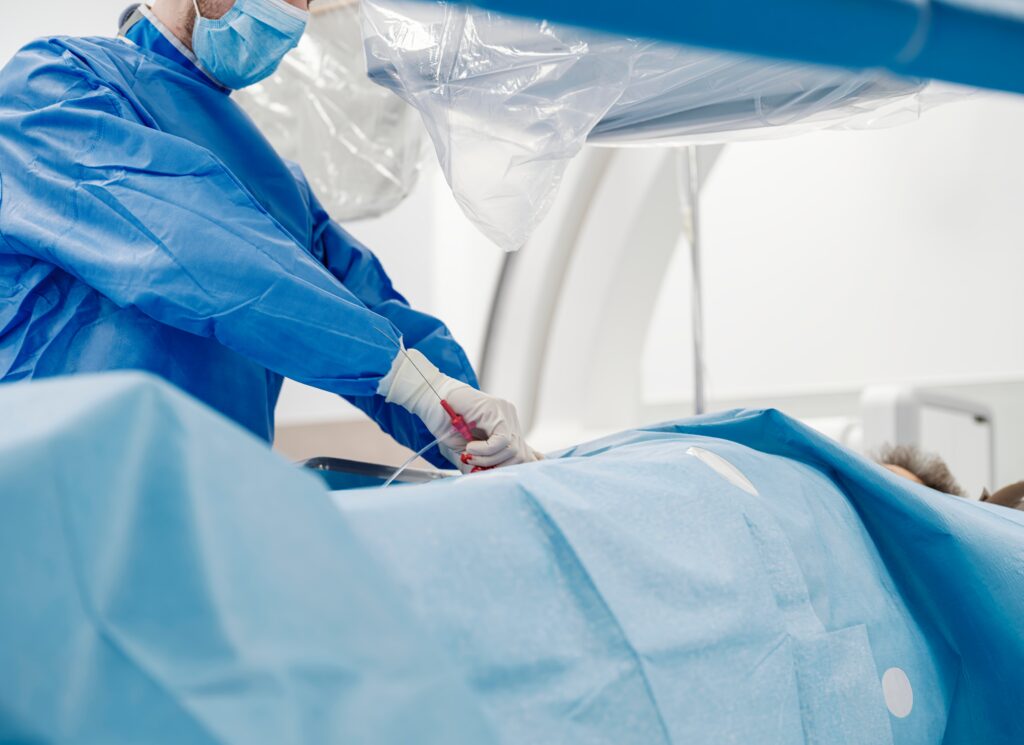
PAE is performed in an office setting through a small nick in the skin, using real-time imaging. You get light sedation — no general anesthesia. Your doctor guides a thin tube to the prostate arteries and places the micro-beads.
You go home the same day with minimal restrictions — and unlike surgery, no urinary catheter. Symptoms improve as the gland shrinks over the following weeks. We schedule a follow-up to track your progress.
What this means for you
Sleep through the night again
As the prostate shrinks and pressure on the urethra eases, most men make fewer nighttime trips to the bathroom.
Protect what matters
Because the prostate is never cut, PAE carries little to no risk of the urinary or sexual side effects associated with prostate surgery.
An office procedure, not a hospital stay
Done through a tiny nick in the skin. Home the same day, no catheter, minimal restrictions.
The things people actually want to know
This is the question most men actually want to ask — so let’s answer it plainly. Because PAE shrinks the prostate without cutting or removing tissue, it carries little to no risk of the sexual side effects linked to prostate surgery. That’s one of the main reasons men choose it.
No — patients go home the same day without a urinary catheter. That’s a meaningful difference from traditional prostate surgery.
No. BPH stands for benign prostatic hyperplasia — it’s a non-cancerous enlargement of the gland that’s common as men age. It still deserves treatment, because the symptoms tend to worsen over time.
You’ll need someone to drive you home the day of your procedure because of the sedation. Most people can drive again the next day — your doctor will confirm what’s right for you before you leave.
Medicare and most major insurance plans cover medically necessary procedures like this one. And you won’t have to guess: we verify your benefits before anything is scheduled and tell you exactly what to expect, so there are no surprises.
That’s exactly who PAE was developed for. If pills aren’t helping — or their side effects are worse than the symptoms — PAE offers a middle path between medication and surgery. It’s also an excellent option for men who aren’t candidates for TURP or other prostate surgery.
One team, your team
Board-certified specialists in vascular, venous, and interventional care review every plan together — so you never feel handed off.
Ready to stop planning your life around a bathroom?
A consultation is the first step — same-week appointments are usually available.
Procedure: prostate artery embolization (PAE) — superselective embolization of the prostatic arteries with micro-beads under fluoroscopic guidance, performed in an office-based lab under moderate sedation. FDA-cleared since 2017; gland volume reduction up to 40%.
Consider referral for: moderate-to-severe LUTS from BPH refractory to alpha-blockers/5-ARIs, patients declining or unfit for TURP, catheter-dependent patients seeking catheter independence, and men prioritizing preservation of sexual function.
Workup we handle: imaging, candidacy assessment, and coordination with the referring urologist or PCP. Your office receives the complete report through the CiC physician portal.